1. Divide Your Syllabus Into Three Categories
Don’t give every chapter the same amount of time.
Divide your topics into:
Strong: Concepts are clear and questions can be solved confidently.
Needs Revision: You understand the topic but need to revise formulas, provisions or important concepts.
Weak: You struggle to understand or apply the topic without referring to your notes.
This simple classification helps you spend more time where it is actually needed.
2. Make Revision Active
Revision should not always mean reading your notes again.
Before opening your book, try to recall:
* What are the main concepts?
* Which formulas or provisions do I remember?
* Can I explain the topic without looking at my notes?
* Which questions did I find difficult earlier?
Then check your notes and identify what you missed.
This approach makes revision more effective because you are actively recalling information instead of simply reading it.
3. Combine Revision With Question Practice
For CA Intermediate, understanding a concept is only the first step. You also need to know how to apply it.
After revising a topic, solve relevant questions without immediately checking the solution.
For practical subjects, practise complete calculations. For theory-based subjects, practise recalling important provisions and presenting answers clearly.
Don’t focus only on the number of questions you solve. Pay attention to what your mistakes are teaching you.
4. Plan Multiple Revision Rounds
Trying to revise the entire syllabus only once can make the final weeks stressful.
A better approach is to plan multiple rounds:
First Revision: Cover the syllabus and identify weak areas.
Second Revision: Strengthen difficult topics and practise more questions.
Final Revision: Focus on formulas, provisions, summary notes and your personal error list.
Each round should become more focused and quicker.
5. Keep an Error Notebook
Write down important mistakes you make during question practice.
For example:
* Forgot a provision
* Made a calculation error
* Confused two concepts
* Missed an important point in an answer
Keep the notes short. The purpose is to create a quick revision tool that you can review before tests and examinations.
6. Practise With a Time Limit
Knowing how to solve a question and solving it within the required time are different skills.
During revision, practise questions with a timer and analyse your performance afterwards.
Ask yourself:
Did I spend too much time on one question?
Were my mistakes avoidable?
Did I know the answer but struggle with presentation?
This type of practice can make you more comfortable with examination conditions.
7. Use the Right Study Resources
Students often collect too many books, notes and online resources.
Additional resources can certainly help, but they should not replace the core material and examination-oriented resources provided by ICAI.
Use your resources with a clear purpose. If one source explains a topic well and you are comfortable with it, there is no need to keep switching between multiple sources.
More study material does not automatically mean better preparation.
8. Follow a Realistic Revision Schedule
Your revision plan should be something you can actually follow.
Instead of setting unrealistic study-hour targets, create specific daily goals.
For example:
Revise selected chapters → Practise questions → Analyse mistakes → Review weak areas
Keep enough time for revision and mock-test practice rather than using all your time simply to complete chapters.
Consistency is more useful than an ambitious timetable that lasts only a few days.
A Simple Revision Formula
If you are unsure where to start, remember:
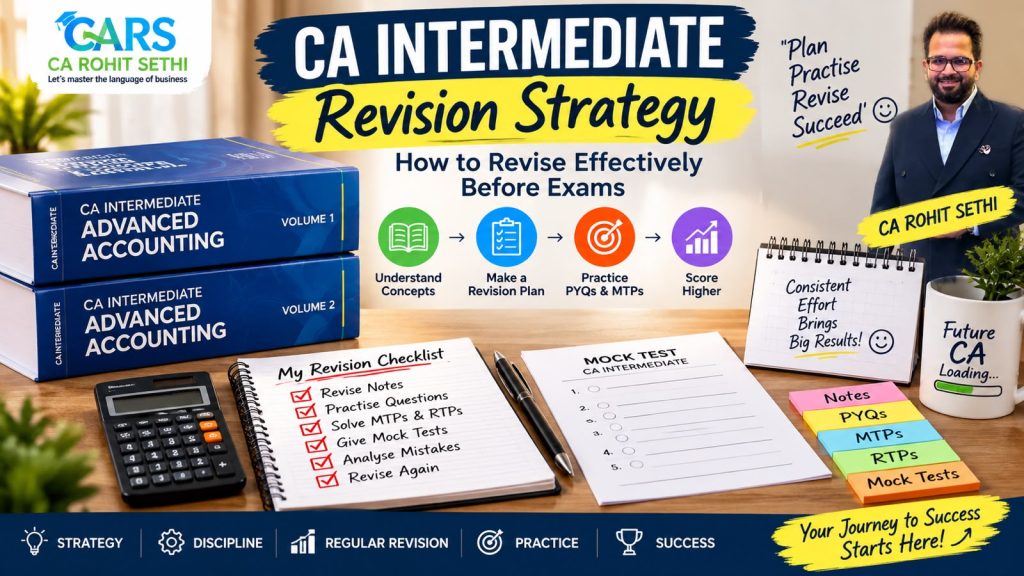
Revise → Recall → Practise → Analyse → Repeat
Revise: Refresh the concept.
Recall: Try to reproduce it without looking at your notes.
Practise: Apply it through questions.
Analyse: Identify your mistakes.
Repeat: Revisit weak areas.
This turns revision into an active learning process rather than repeated reading.
Final Thoughts
A good CA Intermediate revision strategy is not about studying for the maximum number of hours. It is about using your available time effectively.
Focus on clear concepts, regular revision, meaningful question practice and honest analysis of your mistakes.
Don’t wait until the final days to discover what you remember and what you don’t. Use your revision period to test yourself and improve your weak areas.
Study with clarity. Practise with purpose. Learn from your mistakes. Build your confidence with every revision.