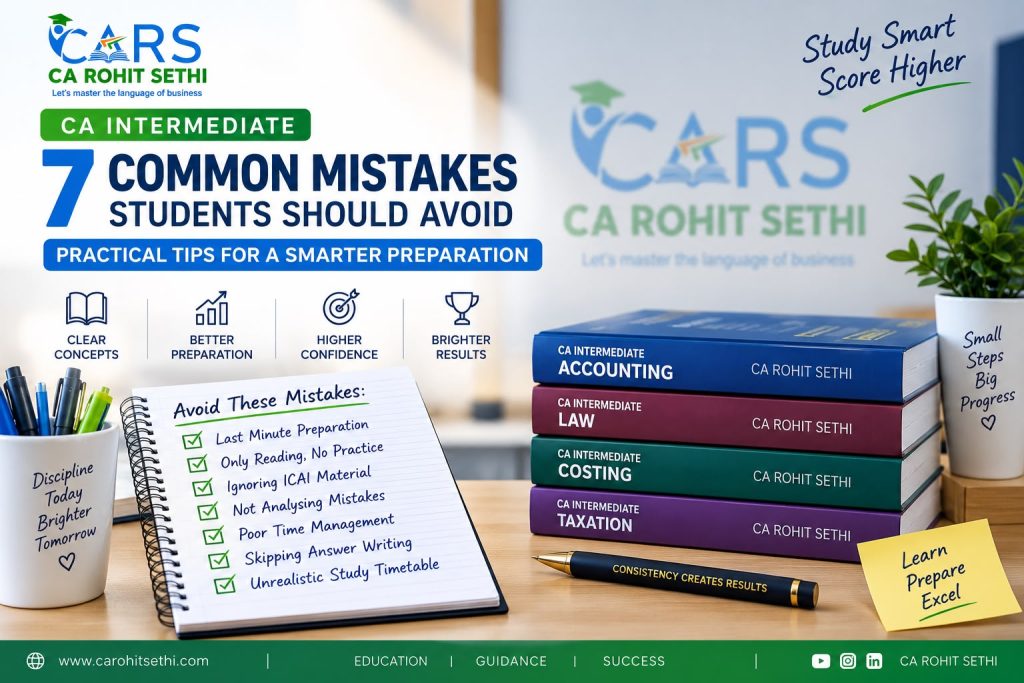
Preparing for CA Intermediate is not just about studying more. It is about studying with the right approach.
Many students put in long hours, complete their classes and revise their notes, yet feel underprepared when the examination gets closer. In most cases, the problem is not a lack of effort. It is often the way that effort is being used.
CA Intermediate preparation requires a balance between conceptual understanding, revision, question practice and time management. Small mistakes in any of these areas can affect your confidence and your performance in the examination.
If you are preparing for the CA Intermediate examination, here are seven common mistakes that you should try to avoid.
1. Trying to Cover Everything at the Last Moment
One of the biggest mistakes students make is postponing difficult chapters and then trying to complete them during the final weeks.
The last phase of preparation should ideally be used to revise what you have studied, practise questions and strengthen weaker areas. It should not become a period where you are learning a major portion of the syllabus for the first time.
If some topics are still pending, first assess their importance and your level of understanding. Then decide how much time they realistically deserve.
A practical approach is to divide your preparation into three categories:
* Topics you know well
* Topics that need revision
* Topics where your understanding is still weak
Spend more time on the areas that can genuinely improve your performance instead of simply trying to tick every chapter off a list.
Remember: completing a syllabus and being prepared for an examination are two different things.
2. Reading More and Practising Less
Reading your notes repeatedly can create a feeling that you know the subject. But when you actually sit down to solve a question, you may realise that recalling and applying the concept is much harder.
This is why question practice should be an important part of CA Intermediate preparation.
After completing a topic, close your notes and attempt relevant questions yourself. In practical subjects, work through calculations step by step. In theory-oriented areas, practise recalling the important points and presenting them properly.
For example, after revising a chapter in Accountancy, don’t stop at reading the illustrations. Solve questions without looking at the solution. If you make an error, identify exactly where your understanding went wrong.
The purpose of practice is not simply to increase the number of questions you solve. It is to improve your ability to apply what you have studied under examination conditions.
3. Ignoring ICAI Study Material and Official Resources
Another common mistake is collecting too many books, notes and online resources while giving insufficient attention to ICAI’s own resources.
For CA Intermediate students, the ICAI Board of Studies provides study material and other examination-oriented resources. The current ICAI BoS ecosystem includes study material, Revision Test Papers, Mock Test Papers, revisionary classes and other exam support resources.
For the September 2026 Intermediate examination, ICAI has also announced Mock Test Paper Series I and II and Live Virtual Revisionary Classes.
This does not mean that you should completely avoid other learning sources. Good reference material can certainly help when a concept needs another explanation.
The important point is to avoid resource overload.
Instead of asking, “What else should I study?”, ask:
“Have I properly understood and practised the material that I already have?”
One well-used source is generally more valuable than five half-used sources.
4. Not Analysing Your Mistakes
This is one of the most overlooked parts of exam preparation.
Students often solve a test, check the marks and move on. But your mistakes can tell you much more than your marks.
Whenever you get a question wrong, try to understand the reason.
Was the concept unclear?
Did you forget a provision or formula?
Was there a calculation error?
Did you misunderstand the question?
Did you know the answer but fail to present it properly?
Or did you simply run out of time?
Maintain a small error notebook for these recurring issues. You don’t need to write long explanations. A short note is enough to remind you what went wrong.
For example:
“Forgot treatment of _.”
“Calculation error in working note.”
“Need to revise provision _.”
Go through these mistakes during revision.
Over time, you may notice that the same types of errors are appearing repeatedly. That is useful information. It tells you exactly where your preparation needs attention.
5. Neglecting Answer Writing and Presentation
Knowing a concept is important, but an examination also requires you to communicate your answer effectively.
Many students practise questions only with the objective of reaching the final answer. They spend less time thinking about how they would actually present that answer in the examination.
Start practising with a timer.
For descriptive questions, focus on understanding what the question is asking and presenting the relevant points in a clear sequence. For practical questions, practise complete workings rather than jumping directly to the final figure.
Timed practice also helps you understand your own speed.
You may discover that you are spending too much time on questions that you initially considered easy. Identifying this during practice gives you an opportunity to correct it before the actual examination.
ICAI has also published specimen answer-book formats for the September 2026 examinations, which students can refer to for familiarity with the relevant answer-book formats.
6. Following an Unrealistic Study Timetable
A timetable is useful only when you can actually follow it.
Students sometimes create schedules based on twelve or fourteen hours of study because it looks productive. But if the plan becomes impossible to maintain after a few days, it creates guilt rather than progress.
Your CA Intermediate study plan should take your actual routine into account.
Consider:
* How much of the syllabus is already completed?
* Which subjects require more revision?
* How much question practice is pending?
* When will you take mock tests?
* Which topics repeatedly cause problems?
* How much time can you realistically study every day?
Your daily targets should be specific.
Instead of writing:
“Study Tax for 5 hours.”
write:
“Revise Chapter 3 + solve 25 questions + review mistakes.”
The second target gives you something measurable to complete.
And don’t forget to leave time for revision. A plan that only focuses on completing chapters but leaves no space for revising them is incomplete.
7. Comparing Your Preparation With Everyone Else
This may not look like a study mistake, but it can have a significant effect on your preparation.
One student may study for eight hours and perform extremely well. Another may need more time to understand the same topic. Someone may have completed the syllabus months ago, while another student may still be working through selected chapters.
Your preparation should be judged against your own progress.
Instead of asking:
“How many hours did my friend study today?”
ask:
“Am I understanding concepts better than I did last week?”
“Am I making fewer mistakes?”
“Can I solve questions without depending on the solution?”
“Am I becoming faster?”
These are much better indicators of progress.
A healthy level of comparison can motivate you, but constantly comparing your preparation with others can make you change your strategy unnecessarily.
Stay with a plan that works for you and improve it based on your results.
A Better Way to Approach CA Intermediate Preparation
Good preparation is not about doing one thing perfectly. It is about creating a cycle that you can repeat consistently:
Understand → Revise → Practise → Analyse
Understand:
Make sure the basic concept is clear before moving ahead.
Revise:
Come back to the topic after a suitable gap instead of waiting until the examination is near.
Practise:
Solve questions without relying on the solution.
Analyse:
Understand your mistakes and work specifically on them.
This approach is particularly useful because it changes preparation from passive reading into active learning.
And remember, ICAI’s current student resources include revisionary classes, mock tests and other exam-support resources, so students should make use of relevant official resources rather than relying only on random material available online.
Final Thoughts
CA Intermediate preparation can feel overwhelming when you look at the entire syllabus at once. The better approach is to focus on what you can improve today.
You don’t need to study every available resource. You don’t need to copy someone else’s timetable. And you don’t need to measure your preparation only by the number of hours spent studying.
Focus on clear concepts, regular revision, meaningful question practice and honest analysis of your mistakes.
If you make a mistake during preparation, treat it as feedback rather than failure. The purpose of practice is to find these mistakes before the examination, not to pretend that they don’t exist.
Most importantly, stay consistent.
Study with clarity. Practise with purpose. Learn from your mistakes. And let your preparation build your confidence.