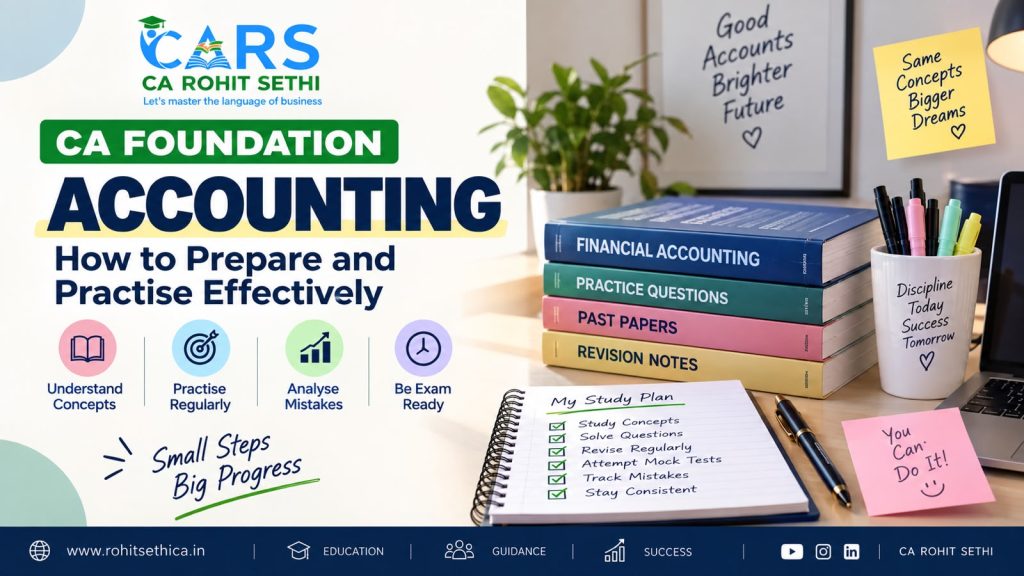
Preparing for CA Foundation Accounting is not about solving hundreds of questions in a day. It is about understanding the logic behind each concept and practising it regularly.
For many students, Accounting is one of the first subjects where studying from a school-level approach is no longer enough. The questions require you to understand the concept, apply the correct accounting treatment and arrive at the answer with accuracy.
The good thing is that Accounting becomes much easier once your basics are clear and you develop a regular practice routine.
So, how should you approach CA Foundation Accounting?
Here is a practical way to prepare the subject without making your study routine unnecessarily complicated.
1. Start With the Basics
Before moving to lengthy practical questions, make sure your basic accounting concepts are clear.
You should be comfortable with ideas such as:
* Accounting concepts and principles
* Debit and credit
* Journal entries
* Ledger
* Trial balance
* Capital and revenue items
* Basic accounting adjustments
These concepts may look simple at first, but they form the foundation for many questions that come later.
If a basic concept is unclear, do not simply memorise the treatment and move ahead. Stop and understand why a particular entry or treatment is being used.
That understanding will save you a lot of time when you start solving application-based questions.
2. Understand the Logic Behind Journal Entries
Journal entries are an important part of your Accounting preparation.
Instead of trying to memorise every entry separately, ask yourself three simple questions:
What has happened in the transaction?
Which accounts are affected?
Why is the account debited or credited?
For example, when you understand why an expense is treated differently from an asset, you are less likely to forget the accounting treatment later.
This approach may take a little more time in the beginning, but it makes revision much easier.
3. Study One Concept and Practise It Immediately
One common mistake students make is completing an entire chapter before solving questions.
A better approach is to follow a simple cycle:
Learn → Understand → Solve → Check → Repeat
After studying a concept, solve a few questions based on it while the concept is still fresh in your mind.
If you make a mistake, don’t just look at the correct answer and move on. Find out exactly where you went wrong.
Was the concept unclear?
Did you select the wrong accounts?
Was there a calculation mistake?
Or did you miss an adjustment?
This small habit can make your CA Foundation Accounting preparation much more effective.
4. Give Enough Time to Practical Chapters
Accounting is not a subject that can be prepared effectively through reading alone.
You need to spend time actually solving questions.
As you move through the syllabus, give regular practice to areas such as Bank Reconciliation Statement, Inventories, Depreciation and Amortization, Bills of Exchange and Promissory Notes, and preparation of financial statements. These are among the areas covered in the ICAI Foundation Accounting material.
Do not wait until the end of the syllabus to start practising.
Even 30–45 minutes of focused problem-solving every day can make a noticeable difference over time.
5. Use ICAI Study Material as a Main Source
While preparing for CA Foundation, students often collect multiple books, notes and question banks.
More material does not necessarily mean better preparation.
Your first priority should be to understand and practise from the ICAI study material applicable to your examination. ICAI currently provides Foundation Paper 1 Accounting study material, including the applicable editions for the respective examination cycle.
Once you are comfortable with the concepts and questions from your main study material, you can use additional questions for practice if required.
The goal should be better practice, not simply more pages completed.
6. Keep a Separate Record of Your Mistakes
This is one of the simplest habits that can improve your Accounting preparation.
Whenever you make a repeated mistake, write it down.
For example:
* Wrong journal entry
* Calculation error
* Incorrect adjustment
* Formula or treatment forgotten
* Question misunderstood
* Final answer not checked properly
You don’t need to maintain a complicated notebook.
Even a few pages dedicated to your common mistakes can become extremely useful during revision.
Before an exam or test, spend some time going through these mistakes. You may find that the same types of errors appear again and again.
7. Practise for Accuracy Before Speed
Students often worry about completing questions quickly.
Speed is important, but accuracy should come first.
When you are learning a chapter, take enough time to understand the question and solve it correctly. Once you become comfortable with the method, start practising the same type of questions with a time limit.
Gradually, you will improve both speed and accuracy.
A useful progression is:
Understand first → Solve correctly → Improve speed → Practise under time pressure
This is much more effective than trying to solve every question as quickly as possible from the beginning.
8. Revise Accounting in Short, Regular Sessions
Accounting tends to become easier when you stay connected with the subject.
Instead of studying Accounting for several hours only once a week, try to include shorter practice sessions throughout the week.
Your revision can include:
* Revising important concepts
* Re-solving questions you got wrong
* Practising journal entries
* Reviewing adjustments
* Solving selected practical questions
* Checking your previous mistakes
Regular revision also helps you remember the method of solving a question instead of having to relearn it before every test.
9. Solve Questions Without Looking at the Solution
There is a big difference between understanding a solution and being able to solve a question yourself.
When practising, keep the solution aside and attempt the question on your own.
If you get stuck, give yourself some time to think about the concept before checking the answer.
Once you see the solution, compare your approach with it.
Ask yourself:
Where did my approach change?
This will help you identify the exact area that needs improvement.
10. Prepare With the Exam in Mind
As your preparation progresses, your practice should slowly move towards exam conditions.
Try solving questions within a fixed time. Practise presenting your working clearly and avoid depending on the solution while solving.
ICAI also publishes examination resources such as Revision Test Papers and previous question papers for Foundation examinations, which can be useful for exam-oriented practice.
The purpose of this practice is not only to test what you remember.
It is to see whether you can understand, apply and complete the question accurately within the available time.
Final Thoughts
CA Foundation Accounting becomes much more manageable when you stop treating it as a subject that needs to be memorised and start treating it as a subject that needs to be understood and practised.
Build your basics first. Understand the logic behind journal entries and accounting treatments. Practise questions regularly, use the ICAI study material properly and keep track of the mistakes you make.
You do not need to solve everything in one day.
What matters more is consistency.
Understand the concept. Practise the method. Learn from your mistakes. Build your confidence.
With the right approach and regular practice, Accounting can become one of the subjects where your preparation shows clearly in your performance.